Thursday, April 5, 2012

Food Book Club Time

Stealing Buddhas Dinner is a memoir written by a Vietnamese-American Bich Minh Nguyen. Nguyen recalls her childhood memories through nostalgic memories of food. As a young immigrant child, Bich struggles to find her new American identity while still maintaining her original cultural identity of her Buddhist Vietnamese roots.

Nguyen uses food to contrast the difference between the two unique cultures. While she is forced to eat rice and vegetables, Bich watches in envy as other local Michigan girls eat Pizza and other traditional American "delicacies". Going against her families traditional wishes, Bich feels she must assimilate into the American culture by eating what she thinks an American would eat. However this American food represents something deeper for Bich, it represents her integration into American society and her own created American identity. While Bich pursues her idea of the American diet and lifestyle, her family drama unfolds and the reader learns about the hardships of immigrating to a brand new place, being accepted and finding an identity. While I felt certain memories and stories where rather dry and boring in Nguyen's writing style, this book's true value comes with insight into cultural assimilation and the nostalgic stories of food products we've all grown up with and enjoy in America.

Cupcake Wars: Food Porn

 Cupcake Wars is a Food Network show that is sweeping the nation, well maybe not the entire population but it is surely popular with cupcake enthusiasts everywhere. I personally watch this show for the ridiculous premise that provides me with guilty bursts of laughter at the overall stupidity and utter pointlessness that goes on throughout the "competition". Every new episode "four of the country’s top cupcake bakers face off in three elimination challenges until only one decorator remains". The show does its best to create tension, stress, and drama but lets face it, they're making cupcakes, not such serious and stressful business. I have theory that people don't watch for the the cupcake drama  but rather for the "food porn" factor. Each round the eager-to-please contestants are judged on their cupcake's presentation and taste. Between intensely heated rounds, the highly qualified and most-likely certified cupcake judges provide in depth cake feedback, which most of the time borders on erotic descriptions of aesthetics and taste.


In the grand finale the remaining two contestants must make a display with 1000 cupcakes on it (most of which are probably never eaten, lets hope they donate them to a cupcake needy charity!). These displays always have a ridiculous tacky theme and the cupcakes and displays from both contestants almost always end up nearly identical, because how many ways can you make a World Cup trophy with cupcakes on it? What a waste of 2000 cupcakes! This is food pornography at its finest, the audience sits at home, lusting over dirty thoughts of the  thousands of glamorized cupcakes that they will never have the chance to eat!


The Word for Word Production of "Sorry Fugu"

T.C. Boyle's short story "Sorry Fugu" was adapted to the the stage by the Word for Word Performing Arts Company a professional San Francisco theater ensemble. This interesting production really tried to stay true to the original text written by Boyle, so much so that at times characters would speak in the first and third person to describe the actions taking place on stage. The quirky characters all were brought together over the world of fine dining. While the eager-to-please cook does everything in his power to impress the harshest of food critics for a coveted good review, we learn of the characters unique personalities. While a few minor mishaps in the production occurred the cast played it off seamlessly leaving the audience enthralled by their comical exploits.

 At the end the audience finds out if the cooks seductive efforts to impress pay-off, as the critic becomes almost erotically aroused by a dish presented in front of her. This brings up themes of lust and indulgence, and the interesting topic of food porn- "a glamorized spectacular visual presentation of cooking or eating". While the play was well done and had its amusing scenes I doubt I would have much interest in the story if I had not read the short story previously. Maybe my overall contempt for plays comes from my generation's general lack of an attention span for anything that is not a flashing screen, but I still have respect for the quality of this production.

Thursday, March 1, 2012

Foer's Eating Animals: Provactive Ideas, But Can He Change America?


Jonathan Safran Foer's non-fiction auto-biographical and factually informative book Eating Animals is a testament to the evils of factory farming. Many critiques have been made, both positive and negative, interpreting Foer's overall message and presentation on the complicated issues of food production. When reading Eating Animals I found Foer's general thesis best to be summed up by one of his harshest critics. In her critical article writer Jennifer Reese elegantly states "It is absolutely true that the ancient ties between people and animals have been grotesquely perverted by industrial agriculture, as the strongest portions of Foer's book make horrifically clear. But, unlike Foer, I believe that fixing the relationship is both possible and worthwhile. To declare that humanity should opt out of this relationship altogether strikes me as less heinous but every bit as arrogant and unnatural as the factory farm." Foer is against all unnatural and believes everybody in America should convert their factory meat eating ways.

I personally whole-downheartedly want to believe and buy into Foer's message. However, I also believe he's living in an ideal state of mind in which the majority of Americans are incapable of reaching. Foer has bought into his own message for his family's health and societal impact. I believe his ideals are unreasonable for the majority of Americas for multiple different economical and lifestyle reasons.  Foer's revelations towards the grotesque horrors of factory farms and his lifestyle idea to boycott them completely is a very agreeable and positive statement that should never be criticized. I also profess that I think the American people can't change unless factory farming is cut out entirely. Basically, if it is there, the majority will eat it. The American people are not capable of such drastic industrial, agricultural, economical, and lifestyle changes without more of a dire driving force, Foer's revealing gross-out tactics are apparently not enough.
 
It is hard to argue against most of Foer's researched content. His research provides personal insight and compiled factual evidence that truly reveals the grotesque nature of factory farming. This information had me rethinking what I was mindlessly eating prior to reading Eating Animals. Another harsh critic of Foer's book, Jim Raynor writer for The Observer states in his critical article "The reality is that the raising of animals for food is an ugly business, however unintensive the methods used. That's a truth we must confront. There is no doubt that we have become too divorced from our food production system. We need to know how it works. We need to know what eating meat means." I prefer for food production to be out of sight and out of mind for the sole reason it is gross. However with these new revelations the possibility for me to enjoy the "potentially gross but good tasting" is far less, to the point now where I'm cutting foods I've once ate out of my diet completely.
 

In conclusion I would definitely recommend Eating Animals to anybody looking for a revealing look into how our food is made. While I believe factory farming may be necessary for America currently, the U.S. food lifestyle can change when the general outlook of the population changes. With education and time perhaps America will wake up and make an informed decision about regulating factory farmed meat.

Should We Eat Turkey For Thanksgiving?


When I think 'Thanksgiving', the first thing that comes to mind is turkey. From early childhood we've all traced our hands creating that distinctive traditional symbol of thanksgiving- the hand-turkey. How could this seemingly harmless traditional bird be a menace to American society? Turkey meat originally in it self is a generally healthier meat as seen here in Worlds Healthiest Foods Organization. The problem isn't the bird, but the way the bird is raised. Factory farming is essentially poisoning the American population with overly-processed, hormone induced meat. Jonathan Foer's book Eating Animals is a testament to the  growing idea of factory farming being destructive and inhumane.

But why take such a stand against turkey? Why would you challenge something this traditional and integrated into American society? Jonathan Foer takes a strong stance against turkey when he states  "Given their vulnerability to disease, turkeys are perhaps the worst fit of any animal for the factory model. So they are given more antibiotics than any other farmed animals. Which encourages antibiotic resistance. Which makes these indispensable drugs less effective for humans. In a perfectly direct way, the turkeys on our tables are making it harder to cure human illness." These factory farmed Thanksgiving traditions seem like they could cause a great deal of harm and according to Foer over 45 million turkeys reach American dinner tables every Thanksgiving.  So, should we eat turkey for Thanksgiving?


I believe turkey is an embedded tradition in American society. However now that I know the facts about the turkey most Americans have been eating, my thoughts towards turkey has changed. I agree with Foer in the fact the vast majority of the population will continue to support and eat the Thanksgiving bird, even with the harmful facts exposed to the public knowledge. However it should not be the generals populations responsibility to simply end all support for factory farmed products. Foer simply states "Cruel and destructive food products should be illegal." Until regulations and alternative low-cost mass production methods can be made possible, factory farming will exist. Despite being seemingly evil, factory farming is a necessary industry providing cheaper food and jobs to the masses.

While these food products should be highly investigated and probably illegal, they will exist until  major industrial  and societal change can be made throughout America. Americans must become conscience of what they are eating. We should all question what we are putting into our mouths? What is it really made of? Where did it come from? We have to start becoming a health conscience nation. We must start supporting organic farming on a grand scale and consider all the alternatives to factory farmed products. As Americans, we must create a change in food culture, for the sake of our society's overall health.

As for me, I will continue to eat turkey for Thanksgiving for tradition. However, I will certainly question the turkey I'm being served for Thanksgiving. I will research and encourage organic turkey and make sure the way the turkey is raised matches my personal standards for a healthy meal, natural and free of hormones. So America, will you eat turkey this Thanksgiving? If you chose to partake in this tradition, all I ask is to question how the bird was raised and be thankful it is (hopefully) not factory farmed!

Thursday, February 16, 2012

Fast Food and Obesity: The Connection (?)

Zac Weathers
Fast Food and Obesity: The Connection (?)


 Everywhere you look across the U.S. I guarantee  you will find a growing number of fat people. I've eaten fast food avidly all my life and thankfully I've stayed fit. Someday this indulgence in unhealthy fast food may catch up to me. However for many Americans this glutinous lust has not only caught up to them, but won the race. According to the Surgeon General 1 and 8 American deaths are caused by obesity related illness. This startling figure lead me to the question; Why are Americans getting fat and dying like never before? I believe the fast food industry plays a crucial role in the United State's obesity epidemic.


The United States average Body Mass Index has been increasing steadily since the early 1900’s just as the average lifespan has increased. Throughout history the wealthy have generally been plump due to their lavish living standards. But in today’s culture "skinny" is in, so the growing number of obese Americans should seem odd. A major problem throughout history has been people dieing of being malnourished. In modern America the tables have turned, now we die from too much food! American society has progressed in such away that most of the citizens can live lavish lifestyles similar to wealthy ancients, but this lifestyle flourishes throughout the general population.

This increase in Body Mass Index is the result of an evolution of American society. We are becoming bigger simply because our calorie intake is increasing. In her obesity viewpoints article Laura K. Egendorf states that “on average, Americans are eating about 200 calories more each day than they did in the 1970’s”. This leads to the mystery of were these calories are coming from. According to the U.S. Department of Agriculture’s Continuing Survey of Food Intakes by Individuals “Americans are not eating bigger breakfasts, lunches, or dinners- but they are noshing and nibbling like never before”.  We have become a snacking nation, adding countless empty calories into our diets.

America’s relative food costs have steadily decreased from the early 1920’s. The USDA’s Economic Research Service states that “In 1929, families spent 23.5 percent of their income on food. In 1961, they spent 17 percent. By 2001, American families could spend just 10 percent of their income on food.” With the American lifestyle, food has become a secondary thought. It has become so readily available, we have steadily increased the amount we consume through snacking and the abundance of foods, healthy and unhealthy. Obviously those who live a sedentary lifestyle with an abundance of calories and food choices are more than likely to become obese.

While the typical American lifestyle  may seem like it is setting people up to become obese, many argue that fast food corporations are a major contributing factor in the obesity epidemic. Multiple studies have been done in the attempt to fully link fast food consumption to increasing obesity risk. One major linking factor is the fact that people living in a close proximity to fast food restaurants are at risk for increased weight gain. A study by the National Bureau of Economic Research surveyed ninth graders to find those “whose schools are within a block of a fast-food outlet are more likely to be obese than students whose schools are a quarter of a mile or more away.” Other surveys and statistics have been compiled all linking living in a close proximity to a fast food facility with higher obesity and weight gain statistics. This shows that when highly convenient and readily available fast food consumption increases obesity risk. Through clever advertising campaigns fast food has successfully been integrated and accepted into American culture and society. Most Americans seem to ignore the fact that fast food consumption can significantly increase the risk of becoming overweight or obese.


Fast Food corporations are pulling off one big cover-up. Behind the enticing masks of corporate branding and genius advertisement the fast food corporations have successfully downplayed the harmful/unhealthy aspects of their products. They accomplish these diversions by advertising seemingly healthier options like salads, toys/endorsements/corporate branding to attract children, sex to entice adults, and multiple other methods to draw away from the fact that fast food products are unhealthy.

When will America wake up? When will we realize we're being duped? When will we realize that fast food does make you fat?

The fact of the matter is that Americans are becoming fatter. With an increase in calorie intake, abundance of unhealthy and processed food, and increasing amount of people living sedentary lifestyles the epidemic is growing. 30.6 percent of the general American populace is considered obese and approximately 50 percent of American is over the healthy weight limit (AKA overweight). While there are multiple factors that can possibly contribute to obesity risk, one thing is certain. America is facing a growing epidemic of unhealthiness.


Bibliography
                             
                              Egendorf, Laura K. “Fast Food Should Not Be Blamed for Obesity.” Opposing Viewpoints
                                          Resource Center February 2005. February 2010
                             
                              Decision News Media “Fast food consumption increases obesity risk.”        Foodnavigator.com May 2004.  February 2010

                              Rabin, Roni Caryn. “Proximity to Fast Food a Factor in Student Obesity”  NY Times             March 2009. February 2010

Tuesday, February 7, 2012

The Fast Food Epidemic

Zac Weathers
The Fast Food Epidemic

There is no question that America is facing an epidemic. According to www.nationmaster.com approximately 30.6% of the United States  population are considered obese by their calculated height, weight, age, and Body Mass Index. This alarming trend is apparent anywhere you travel across the States, but around the world this is not the case; people, for the most part, are in shape. What makes Americans so fat? Many would argue that American obesity is caused by our abundance of food choices, eating habits, and overall American gluttony.

However, there is another side that argues that it is not originally to blame on American attitudes of gluttony, but the food corporations, which have seemingly duped the American public into using their products excessively contributing mightily to the obesity epidemic. Both sides of the issue are debatable; however, there is no clear defining reason for the big question. Why are Americans so fat?
With the American lifestyle, food has become a secondary thought. It has become so readily available we have steadily increased the amount we consume through snacking and the abundance of foods, healthy and unhealthy. Those who live a sedentary lifestyle with an abundance of calories and food choices are more than likely to become obese.

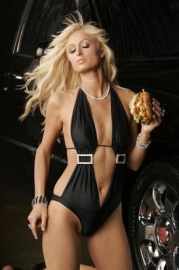
Since the creation of fast food corporations and their advertising, obesity statistics have steadily climbed to the epidemic status we see today. Many question if fast food restaurants are actually a contributing factor to obesity. However as seen in this study done by the National Bureau of Economic Research Fast Food plays a determining factor in obesity statistics.  With massive advertisement campaigns, Americans are bread into a fast food world, where the convenience, price, and taste are integrated into our personalities through constant seemingly subliminal exposure to these giant corporations brands. The fact is that fast food is not healthy and is a leading cause in America’s unhealthy epidemic; don’t let those Paris Hilton ads fool you.

  http://money.cnn.com/2005/05/24/news/newsmakers/carls_ad/